
Commercial Fuel Tank Installation & Replacement
& Design
Supply
& Controls
& Removal
Commissioning


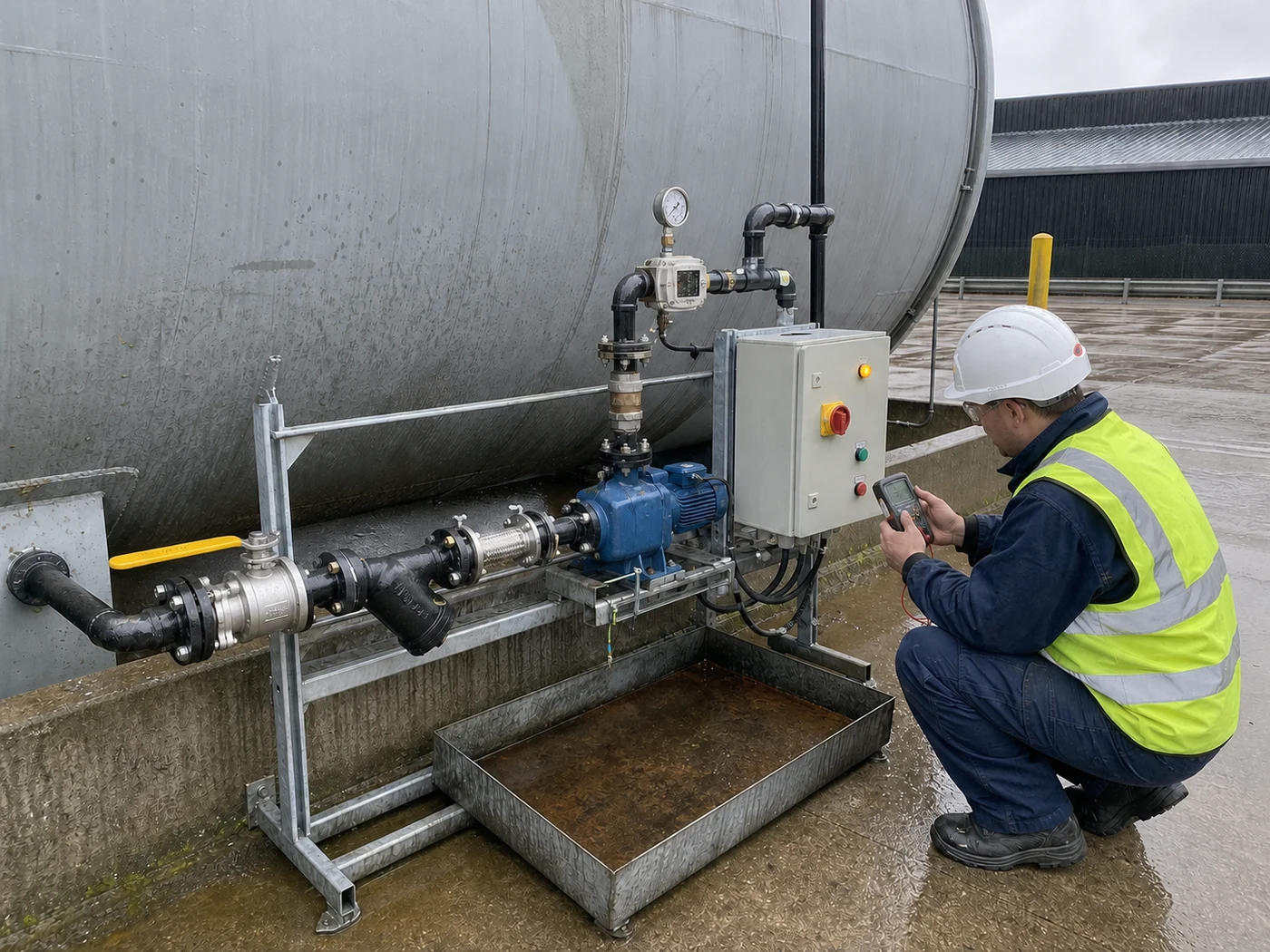
Commercial Fuel Tank Installation, Oil Tank Installation & Bunded Storage Systems Across the UK
Britteco provides commercial fuel tank installation and commercial oil tank installation for industrial sites, depots, generator rooms and commercial facilities across the UK — covering the tank, the base, the pipework and everything needed to bring the system into service.
Most projects are replacements rather than new-build. An existing tank has reached the end of its service life, the bund no longer meets current guidance, or the pipework has become unreliable. Britteco can drain, clean, gas-free and remove the old system and install the new one as a single programme of work, under one set of RAMS.
What a Britteco Installation Covers
A commercial fuel tank installation is rarely just the tank. The supporting equipment, the containment and the pipework are what determine whether the system is safe, compliant and workable day to day.
Tank Supply
Bunded steel and bunded plastic tanks, standard capacities and bespoke sizes. Specification driven by fuel type, demand, available space and site conditions — not by what is easiest to source.
Bases & Groundworks
Reinforced concrete bases, support steelwork, bund construction and level preparation. Existing bases assessed for condition and load before reuse.
Fuel Pipework
Steel and plastic fuel lines, offset fill points, supply and return runs, above-ground and below-ground routes. All new pipework pressure-tested before handover.
Pumps & Dispensing
Transfer pumps, dispensing pumps, hose reels, nozzles, litre meters and filtration — sized to the actual fuel draw rather than a generic specification.
Gauges, Alarms & Monitoring
Contents gauges, overfill prevention alarms, high-level alarms, leak detection and telemetry. Interfaces to BMS or fuel management systems where required.
Removal of the Old System
Fuel uplift, tank cleaning, gas-free certification, cold cutting, removal and licensed disposal of the redundant tank and pipework — Britteco's core specialism.
Our Installation Process
Every installation follows the same structured route — from survey and design through to commissioning, certification and handover. Timescales and sequencing are agreed with the site before works begin.
Site Survey & Design
Assessment of the existing arrangement, access routes, fuel demand, available space, drainage proximity and any constraints affecting siting. System layout and tank specification developed from the survey findings.
Specification & Quotation
Tank type, capacity, containment, pipework routes and equipment confirmed in writing. Quotation covers the full scope — including removal of the existing system where applicable — so there are no mid-project surprises.
RAMS & Project Planning
Site-specific Risk Assessment and Method Statement prepared, covering hot work controls, confined space where relevant, environmental protection and lifting operations. Approved by the client before mobilisation.
Decommission & Remove
Where a tank is being replaced: fuel uplift, tank cleaning, gas-free certification, cold cutting where required, removal of the redundant tank and pipework, and licensed disposal with full waste documentation.
Base & Containment
Reinforced base, support steelwork or bund works prepared and cured as required by the tank specification and site conditions. Existing bases assessed and reused only where condition and loading allow.
Delivery & Positioning
Tank delivered and craned into position using HIAB or mobile crane, with lift plan and exclusion zones agreed in advance. Restricted access and live-site constraints planned around rather than worked around.
Pipework & Equipment
Fill point, vent, supply and return lines installed and supported. Pumps, filters, gauges, alarms, leak detection and monitoring equipment fitted and connected to the agreed specification.
Testing, Commissioning & Handover
Pipework pressure-tested, alarms and gauges function-tested, system filled and commissioned. Documentation issued on completion — installation records, waste transfer notes and gas-free certificates where applicable.
Tank Types & Systems We Install
The right tank for a commercial site is decided by fuel type, storage volume, available footprint, delivery access and how the fuel is actually drawn — not by what is quickest to order. A yard tank feeding plant on a construction compound and a bulk tank feeding a standby generator at a data centre are very different specifications, even at the same capacity.
Britteco specifies and installs bunded steel and bunded plastic tanks across standard commercial capacities, along with bespoke arrangements where site layout or required volume is less conventional.
Fuels Covered
- Diesel — commercial bulk storage, fleet and plant refuelling, generator fuel
- Gas oil — commercial and industrial gas oil storage, including red diesel applications
- Kerosene & heating oil — commercial heating systems and process applications
- HVO — where sites are transitioning from fossil diesel to renewable alternatives
A note on standby applications. Diesel stored in low-usage generator tanks degrades over time — water ingress and microbial growth are the usual culprits. If the system is being installed for standby power, fuel quality management should be planned in from day one rather than dealt with after the first failed load test.
Fuel Tank Replacement
Most commercial installations are replacements. The tank has reached the end of its service life, an inspection has flagged the bund, or the pipework has become the weak point in the system. The complication is rarely the new tank — it is safely getting the old one out.
Like-for-Like Replacement
The existing tank is drained, cleaned, gas-freed and removed, and a new bunded tank installed in the same position. Where the base is sound and correctly sized, it can often be reused — reducing both cost and programme.
Typical for: Above-ground tanks at the end of service life, bunds no longer meeting current guidance, corroded steel tanks.
Relocation & Upgrade
The replacement is sited differently — moved away from a drain or boundary, brought above ground from an underground installation, or increased in capacity. This involves new base and containment works and re-routed pipework.
Typical for: Underground-to-above-ground conversions, sites where siting no longer meets separation requirements, capacity increases.
Removal Only
Where storage is being taken out of use entirely rather than replaced — decommissioning, foam filling or full removal with licensed disposal and site reinstatement, without a new tank going back in.
Typical for: Site closures, fuel switching, redundant underground tanks, property sales requiring evidence of decommissioning.
One Contractor, One Programme of Work
Replacing a commercial fuel tank normally means coordinating cleaning, gas-freeing, cutting, removal, waste disposal, groundworks and installation. Britteco already carries out the removal side as core business — so it does not need to be split across separate contractors and separate RAMS.
Single Point of Contact
One team responsible for removal and installation — no gap between contractors where responsibility gets lost
Gas-Free Certification
Tanks cleaned and gas-freed in-house before any cutting, lifting or transport takes place
Cold Cutting Capability
Spark-free cutting where hot work permits cannot be obtained or the atmosphere makes it unsafe
One Waste Chain
Residual fuel, sludge and scrap handled through licensed channels with waste transfer documentation
Compliance & Regulations
Commercial fuel storage is regulated from the design stage, not signed off at the end. Requirements vary between England, Wales, Scotland and Northern Ireland, and depend on tank size, fuel type and where the tank sits relative to drains, watercourses and boundaries — so applicable requirements are confirmed at survey rather than assumed.
Secondary Containment
Above-ground oil storage at business premises above 200 litres generally requires secondary containment. A bund is normally required to hold at least 110% of the tank capacity — or, where tanks share a bund, 110% of the largest tank or 25% of total volume, whichever is greater.
DSEAR & Fire Separation
Where flammable liquids are stored or used in the workplace, DSEAR 2002 applies. Siting also has to account for fire separation distances from buildings, boundaries and non-fire-rated structures — which frequently determines where a replacement tank can actually go.
OFTEC & BS 5410-2
Britteco is OFTEC registered. BS 5410 Part 2 covers oil firing installations at non-domestic premises and applies to commercial oil storage installations — governing tank siting, base support, pipework and system requirements.
RAMS & Documentation
Site-specific Risk Assessment and Method Statement prepared before every project — covering lifting operations, hot work controls, confined space where relevant and environmental protection. Installation records and waste documentation issued on completion.
Accreditations & Certifications

OFTEC Registered

CHAS Accredited

APEA Member

SPA Passport Certified

APHC Member
ISO 9001
Quality Management
System · Certified
Why Choose Britteco for Tank Installation
Anyone can drop a tank onto a base. The value is in the survey that gets the specification right, the removal of whatever is already there, and the commissioning that proves the system works before the site relies on it.
Removal Specialists First
Britteco's core business is tank cleaning, gas-freeing, cold cutting, decommissioning and removal. On a replacement project, the difficult half is already in-house — not subcontracted out and hoped for.
25+ Years in Fuel Storage
Over two decades working on commercial and industrial fuel storage systems across the UK — manufacturing, agriculture, transport depots, fuel depots, construction, data centres, healthcare and public sector sites.
Live-Site Experience
Restricted access, confined compounds, occupied buildings and shutdown windows are the normal working conditions rather than the exception. Works are phased around site operations, not the other way round.
Honest Specification
If the existing base can be reused, we will say so. If a smaller tank suits the actual fuel draw better than the one requested, we will say that too. Survey findings drive the quotation rather than the other way round.
Nationwide Coverage
Commercial and industrial fuel tank installation delivered across England, Scotland and Wales — from single-site replacements through to multi-site managed estates and planned asset replacement programmes.
Fuel Quality Aftercare
Britteco also provides fuel polishing, sampling, tank inspection and cleaning — so a system installed today has a maintenance route already in place rather than being handed over and forgotten.
Domestic Oil Tank Installation & Replacement
Most of this page deals with commercial and industrial fuel storage — but the same OFTEC-registered engineers also install and replace domestic heating oil tanks across the UK, through Britteco and its sister company LV Fuel Services. If you are a homeowner, you are in the right place.
Old Tank Removed
Remaining oil drained and recovered, tank cleaned, cut down where access requires it, removed from site and disposed of through licensed channels.
Base & Siting
New base laid or existing base assessed, with siting checked against OFTEC fire separation distances from buildings, boundaries and fencing.
Bunded Tank Fitted
Bunded plastic or steel tank supplied and installed, with new oil line, filter and fire valve where required, then tested before the system is handed back.
Usually One Day
A straightforward domestic replacement is normally a single-day job. Where a new base is needed, the work is split across two visits to allow curing time.
Send a photo of the existing tank and its position — that is usually enough for an accurate price without a site visit.
A fuel tank installation usually sits alongside other works. Britteco provides tank removal and decommissioning for the system being replaced, tank cleaning and fuel polishing to protect the new one, and tank inspection to keep it compliant.
Frequently Asked Questions
Common questions about commercial fuel tank installation cost, regulations, bunding requirements, tank replacement and the installation process for commercial and industrial fuel storage systems.
Cost depends on tank capacity and construction, the amount of base and containment work required, pipework runs, the pumps and monitoring equipment specified, site access, and whether an existing tank has to be drained, cleaned and removed first. Because these vary enormously between sites, Britteco quotes from an actual site survey rather than a price list. Send tank size, fuel type, site location and photographs and a site-specific quotation can be prepared.
Commercial oil and fuel storage in England is governed by the Control of Pollution (Oil Storage) Regulations, which apply to above-ground oil storage at business premises above 200 litres. Where flammable liquids are stored or used in the workplace, DSEAR 2002 applies. BS 5410 Part 2 covers oil firing installations for non-domestic premises, and OFTEC standards apply to oil storage and oil-firing work. Requirements differ between England, Wales, Scotland and Northern Ireland, and additional building regulation or fire separation requirements may apply depending on tank size and siting. Applicable requirements are confirmed at survey stage for the specific site.
In most commercial applications, yes. Fixed oil storage at business premises generally requires secondary containment, and the bund is normally required to hold at least 110% of the tank's capacity. Where several tanks share a bund, it must typically hold 110% of the largest tank or 25% of the total stored volume, whichever is greater. Siting relative to drains, watercourses and boundaries also affects what is required. The specific requirement for a given site is confirmed during the survey.
Base preparation, support steelwork and containment works are assessed as part of the installation scope. Where an existing base is being reused, it is checked for condition, level and load capacity before the new tank is positioned. Where new civil works are required, these are included in the quotation and coordinated so that the base is cured and ready before the tank delivery date.
Yes, and this is where Britteco's existing specialism applies directly. Replacement projects involve fuel uplift, tank cleaning, gas-free certification, cold cutting where hot work is not permitted, removal of the redundant tank and associated pipework, and licensed disposal with full waste transfer documentation. Removal and installation can be delivered as a single programme under one set of RAMS rather than as separate contracts.
Bunded steel and bunded plastic tanks are supplied across standard commercial capacities, with bespoke sizes available where site layout or required volume is less conventional. Fuels covered include diesel, gas oil, kerosene, heating oil and HVO. The correct specification depends on fuel demand, available footprint, access for delivery and how the storage system will be used day to day.
A straightforward like-for-like above-ground replacement on an existing base can often be completed in a few days. Projects involving new civil works, underground removal, extensive pipework, multiple tanks or restricted access take longer, and base curing time may govern the programme. An indicative timescale is confirmed with the quotation once the survey is complete.
In many cases works can be phased or scheduled around shutdown windows so that critical services are maintained. Options include installing the new tank before decommissioning the old one, temporary storage arrangements, or working to an agreed outage period. The approach is planned at survey stage around the site's actual operational constraints.
Generator and standby power fuel storage is a common application — including bulk tanks feeding day tanks via transfer pumps, and systems serving data centres, hospitals and other critical infrastructure. Tank capacity is normally sized against generator burn rate and expected runtime, and fuel quality management should be considered from the outset, since stored diesel degrades over time in low-usage standby applications.
Yes. A commercial installation normally includes offset fill point, vent, supply and return pipework, isolation valves, filtration, transfer or dispensing pumps, contents gauges, overfill prevention and high-level alarms, and leak detection. Telemetry and interfaces to building or fuel management systems can be included where the site requires remote monitoring.
Yes. Although this page focuses on commercial and industrial fuel storage, Britteco and its sister company LV Fuel Services also install and replace domestic heating oil tanks across the UK — including removal and disposal of the old tank, base preparation, oil line replacement and OFTEC-compliant siting. Domestic enquiries are handled by the same OFTEC-registered team, so it is worth calling either way.
Planning a Fuel Tank Installation or Replacement?
Send tank size, fuel type, site location and a few photographs of the existing arrangement. Britteco will arrange a site survey, confirm the specification and provide a site-specific quotation covering the full scope — including removal of whatever is being replaced.
Free site assessment · No obligation quote · RAMS provided as standard · OFTEC registered · Nationwide coverage
